Prices Incl. VAT
Yes
No
Shed Guttering Installation Advice Using FloPlast Miniflo, Half Round Gutters & Rainwater Collection Systems
Installing guttering on a garden shed is a simple way to manage rainwater, protect timber walls and reduce the amount of water collecting around the base of your building. Without suitable guttering, rainwater can run directly off the roof, potentially causing splashback, damp timber, soil erosion and standing water around the shed foundations.
Whether you're installing guttering on a new garden shed, upgrading an existing summerhouse or adding rainwater collection to a workshop, choosing the correct PVC guttering system and fittings will help achieve effective drainage.
In this Brissco step-by-step guide, we'll explain how to choose the right shed guttering, what components you'll need, how to fit gutter brackets to a timber structure and how to connect your downpipe to a water butt or suitable drainage point.
Shed Guttering Installation Guide
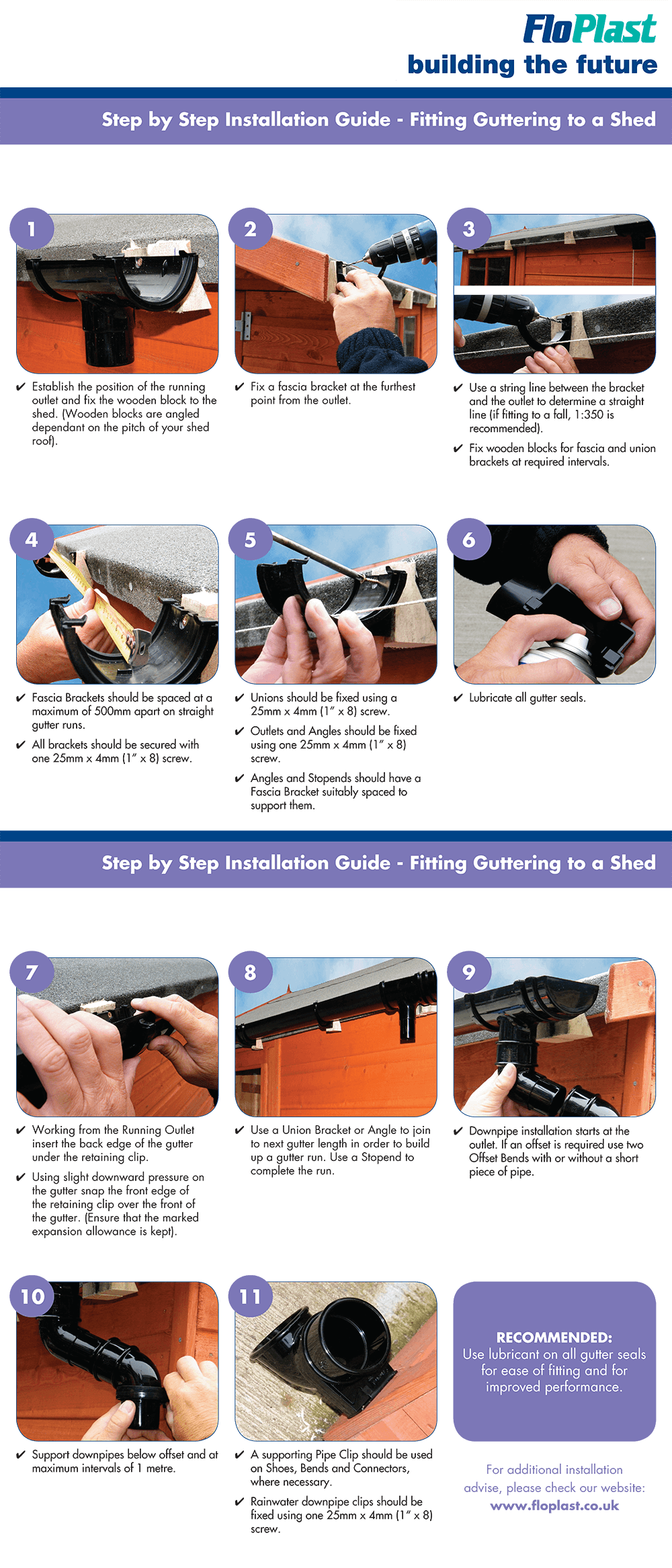
The image provides a useful visual reference for planning your installation. Before starting, measure the shed roofline, identify suitable fixing points and decide where rainwater will be discharged or collected.
Why Should You Fit Guttering to a Shed?
Garden sheds and outbuildings are regularly exposed to rainfall, and water running directly from the roof can create problems over time.
Installing a suitable guttering system helps collect rainwater and direct it away from vulnerable areas.
Key Benefits of Shed Guttering
Protects Timber Walls: Helps reduce rainwater splashback against timber cladding, doors and external surfaces.
Reduces Standing Water: Directs roof water away from the base of the shed and surrounding ground.
Supports Rainwater Collection: Allows rainwater to be collected in a water butt for garden use.
Helps Prevent Erosion: Reduces concentrated runoff around paths, flower beds and foundations.
Improves Drainage: Provides a controlled route for rainwater during wet weather.
What Is the Best Guttering for a Garden Shed?
The most suitable guttering system depends on the shed's roof size, available fixing space, appearance and expected rainwater flow.
FloPlast Miniflo Guttering – Ideal for Smaller Sheds
FloPlast Miniflo is a compact PVC rainwater system designed for smaller roof areas, making it a practical option for many garden sheds, summerhouses, small workshops and outbuildings.
Its smaller gutter profile provides a neat appearance on lightweight garden buildings where standard domestic guttering may look oversized.
Miniflo is available in several colours, including black, white, grey, brown and anthracite grey, allowing the guttering to complement the shed's exterior finish.
Always check the roof area and manufacturer's drainage capacity guidance to confirm that Miniflo is suitable for your installation.
FloPlast 112mm Half Round Guttering – For Larger Outbuildings
For larger sheds, workshops, garages and garden buildings, FloPlast 112mm Half Round Guttering may be a more suitable option.
Its traditional curved profile provides a practical rainwater drainage solution and is available with a wide selection of compatible fittings.
Half Round guttering can be particularly useful where the building has a larger roof area or requires a standard domestic rainwater system.
Can You Use Standard House Guttering on a Shed?
Yes. Standard domestic PVC guttering can be fitted to a shed, provided the roof size, gutter capacity, fixing arrangement and supporting structure are suitable.
However, smaller systems such as FloPlast Miniflo often provide a more proportionate appearance on compact garden buildings.
What Do You Need to Fit Guttering to a Shed?
Before beginning the installation, measure the roofline and identify the components required for your chosen guttering system.
Essential Shed Guttering Components
PVC Gutter Lengths: Collect rainwater from the shed roof and channel it towards the outlet.
Gutter Brackets: Support the guttering and maintain the correct position and fall.
Running Outlet & Stop Ends: Direct rainwater into the downpipe and close the ends of the gutter run.
Gutter Unions & Angles: Connect gutter lengths and allow the guttering to follow changes in direction where necessary.
Downpipe, Bends & Pipe Clips: Carry rainwater towards a suitable drainage point or water butt.
You will also need suitable exterior-grade fixings, a tape measure, spirit level, string line and appropriate cutting tools.
For rainwater collection, a compatible water butt, diverter and connecting fittings may also be required.
How to Fit Guttering to a Shed – Step-by-Step
Step 1: Measure the Shed Roofline
Measure the length of the shed roof edge where the guttering will be installed.
For a typical apex-roof shed, you may need guttering along both sides of the building. A single-slope shed may require guttering along only the lower roof edge.
Identify the position of the running outlet and decide where the downpipe will discharge.
Check the effective roof area and ensure the chosen guttering system has sufficient capacity for the expected rainfall.
Step 2: Check the Shed Fascia and Fixing Points
Before fitting gutter brackets, inspect the shed's fascia board or roof-edge timber.
The supporting timber must be sound, securely attached and capable of carrying the guttering and collected rainwater.
Some lightweight garden sheds have thin roof-edge boards that may not provide adequate support for gutter brackets.
Where necessary, install suitable additional timber support, securely fixed to the shed's structural framework.
Avoid attaching brackets only to thin cladding or unsupported decorative trim.
Step 3: Mark the Gutter Fall
Position the running outlet at the intended drainage point.
Mark the gutter height at the outlet and establish the required fall along the roofline using a string line.
The correct fall depends on the selected gutter profile and the manufacturer's installation instructions.
Ensure the guttering is positioned to collect water running off the roof without allowing water to overshoot the front edge.
Step 4: Install the Gutter Brackets
Fix the gutter brackets securely to the prepared timber fascia or supporting structure.
Follow the manufacturer's recommended bracket spacing for your chosen guttering system.
Use suitable corrosion-resistant exterior fixings of the correct length and diameter for the brackets and timber construction.
Additional brackets may be required near outlets, unions, stop ends and gutter angles.
Check that all brackets follow the intended gutter alignment before fitting the gutter lengths.
Step 5: Fit the Gutter Lengths and Fittings
Measure and cut the PVC gutter lengths to suit the shed roofline.
Ensure the cut ends are square and free from burrs before installing them.
Fit the guttering into the brackets and connect sections using compatible gutter unions where required.
Install the running outlet and stop ends, ensuring the rubber seals are correctly seated and all retaining clips are securely engaged.
Follow the manufacturer's insertion marks to allow for thermal expansion and contraction.
Step 6: Install the Downpipe
Connect the downpipe to the running outlet using compatible bends where necessary.
Position the downpipe against the shed wall and secure it using suitable pipe clips fixed to sound structural timber.
Ensure the pipework is correctly aligned and supported without restricting any required thermal movement.
The downpipe should direct rainwater towards a suitable drainage point or rainwater collection system.
Step 7: Connect the Downpipe to a Water Butt
Collecting rainwater from a shed roof is a practical way to store water for garden use.
A compatible rainwater diverter can be fitted to the downpipe to direct rainwater into a water butt.
Position the water butt on a firm, level and suitable base, following the manufacturer's installation instructions.
Check that the diverter and water butt connections are compatible with your chosen downpipe diameter.
Ensure the water butt has a suitable overflow arrangement so excess rainwater can discharge safely away from the shed when the container is full.
Step 8: Test the Shed Guttering
Once the guttering and downpipe system are installed, check that all brackets, unions, outlets and clips are secure.
Where safe and practical, run water through the guttering to confirm that it flows towards the outlet without leaking or overflowing.
Check that rainwater is directed away from the shed foundations and that any water butt connection operates correctly.
Can You Fit Guttering to a Shed Without a Fascia Board?
Yes, but you will need a suitable alternative fixing arrangement.
Some sheds have exposed rafters or roof-edge structures rather than conventional fascia boards.
Depending on the construction, compatible rafter-mounted gutter brackets or a securely installed timber fascia may provide an appropriate solution.
The fixing method must be suitable for the shed structure and the selected guttering system.
Avoid fixing gutter brackets directly to unsupported roofing sheets, thin cladding or other materials not designed to carry the guttering load.
How to Collect Rainwater from a Shed Roof
A shed roof can provide a useful source of rainwater for watering plants, cleaning garden tools and other suitable outdoor uses.
By connecting the gutter downpipe to a water butt using a compatible diverter, rainwater can be collected rather than discharged directly onto the surrounding ground.
The amount of rainwater available depends on roof area, rainfall and collection efficiency.
For example, a shed roof with a 6m² effective collection area receiving 10mm of rainfall could collect up to approximately 60 litres of water before allowing for losses.
Always ensure that collected rainwater is used appropriately and that the water butt has a suitable overflow arrangement.
Common Shed Guttering Installation Mistakes
Incorrectly installed guttering can lead to leaks, poor drainage or damage to the shed structure.
Common Mistakes to Avoid
Weak Fixing Points: Attaching brackets to thin or unsupported timber can cause the guttering to become loose.
Incorrect Gutter Size: Choosing a system without checking the roof area may result in overflowing during heavy rainfall.
Poor Gutter Alignment: Incorrect positioning can allow rainwater to overshoot the gutter or collect in low spots.
Incompatible Components: Mixing unsuitable gutter profiles, outlets and downpipes can cause connection problems.
Poor Water Butt Overflow: Allowing excess water to discharge against the shed can contribute to dampness and deterioration.
Careful planning and correct installation will help your shed guttering provide reliable drainage throughout the year.
Frequently Asked Questions About Shed Guttering
What size guttering is best for a garden shed?
The best guttering size depends on the shed's roof area and expected rainfall. Compact systems such as FloPlast Miniflo are suitable for many smaller sheds, while larger outbuildings may benefit from standard 112mm Half Round guttering.
Can I fit guttering to a wooden shed?
Yes. PVC guttering can be fitted to a wooden shed, provided the brackets are securely attached to sound timber or another suitable structural fixing point.
Do I need guttering on both sides of my shed?
It depends on the roof design. An apex-roof shed commonly has two roof edges that collect rainwater, while a single-slope roof may only require guttering along the lower edge.
Can I fit guttering to a shed without fascia boards?
Yes, provided suitable alternative support is available. Depending on the shed construction, rafter-mounted brackets or an additional securely fixed timber fascia may be used.
Is FloPlast Miniflo suitable for a shed?
FloPlast Miniflo is designed for smaller roof drainage applications and can be a practical option for many sheds, summerhouses and outbuildings. Always confirm that its drainage capacity is sufficient for the roof area.
Can I connect shed guttering to a water butt?
Yes. A compatible rainwater diverter can direct water from the shed downpipe into a water butt. Ensure the diverter matches the downpipe and that excess water can overflow safely.
How much water can I collect from my shed roof?
As a guide, every 1mm of rainfall falling on 1m² of roof area represents approximately 1 litre of water before collection losses. Actual collection depends on the roof design, rainfall, guttering efficiency and water butt capacity.
Do shed gutters need a fall?
Guttering should be installed according to the manufacturer's recommendations to allow effective drainage towards the outlet. The required fall depends on the selected guttering system.
Can I use normal house guttering on a shed?
Yes, standard domestic guttering can be suitable for sheds and outbuildings where the roof area, fixing arrangement and supporting structure are appropriate.
How do I stop shed gutters getting blocked?
Inspect and clean the guttering regularly, particularly during autumn. Remove leaves, moss and debris, and consider compatible gutter protection accessories where suitable.
Shop Shed Guttering & Rainwater Collection Products at Brissco
At Brissco, we supply a wide range of FloPlast PVC guttering, downpipes and rainwater accessories suitable for garden sheds, summerhouses, workshops and other outbuildings.
Our range includes FloPlast Miniflo and Half Round guttering, together with compatible brackets, unions, outlets, stop ends, downpipes and rainwater collection accessories.
Whether you're fitting guttering to a small wooden shed or installing a complete rainwater system on a larger garden building, selecting compatible components will help ensure effective drainage and long-term performance.
Browse our Miniflo Guttering, Half Round Guttering and Water Butt ranges online, or contact the Brissco team for advice on choosing the right products for your shed.
Always follow the latest manufacturer's installation guidance. Ensure the shed structure is suitable for the chosen fixings and use safe access methods when working at height.

76mm Floplast White Miniflo Gutter 2m
Lead Time - In Stock

FloPlast 50mm Downpipe White Miniflo 2m
Lead Time - In Stock

FloPlast 50mm Downpipe Black Miniflo 2m
Lead Time - In Stock

FloPlast 50mm Downpipe Brown Miniflo 2m
Lead Time - In Stock
Need to see it before you buy? We offer samples of our uPVC building products to help you choose the perfect fit. Simply get in touch through our contact page, and we’ll be happy to assist!

We use cookies on this site to enhance your user experience. For a complete overview of all cookies used, please see our Privacy Policy