Prices Incl. VAT
Yes
No
A Practical Guide to Extruded Acrylic for Signage, Displays & Commercial Fabrication
Extruded acrylic sheet (PMMA) is a lightweight, transparent thermoplastic widely used for commercial signage, retail displays, shopfitting, lighting and fabricated components.
Manufactured through a continuous extrusion process, it generally offers consistent sheet thickness, relatively tight dimensional tolerances and competitive pricing, making it an attractive option for repeat production and larger commercial projects.
Here are ten frequently asked questions to help businesses select the correct extruded acrylic sheet.
1. What Is the Difference Between Extruded and Cast Acrylic?
Both materials offer excellent optical clarity, but their manufacturing processes and fabrication characteristics differ.
Extruded acrylic generally offers tighter thickness tolerances and can be more economical, particularly for repeat production. Cast acrylic is often preferred for detailed engraving, certain machining operations and specialist fabrication.
The best choice depends on the required finish, manufacturing process and project budget.
2. What Commercial Applications Is Extruded Acrylic Suitable For?
Extruded acrylic is commonly used for:
Commercial signage and illuminated displays
Retail point-of-sale stands and shopfitting
Interior partitions and decorative panels
Lighting diffusers and display covers
Fabricated components and equipment covers
For high-impact safety applications, polycarbonate or another appropriately rated material may be more suitable.
3. What Thickness of Extruded Acrylic Should I Choose?
Extruded acrylic is available in a range of thicknesses, with common options including 2mm, 3mm, 4mm, 5mm, 6mm, 8mm and 10mm.
Thinner sheets are often used for signs and displays, while thicker panels may be needed for larger installations or applications requiring additional rigidity.
The correct specification depends on panel dimensions, fixing methods, loading and the intended environment.
4. Can Extruded Acrylic Be Laser Cut, CNC Machined and Polished?
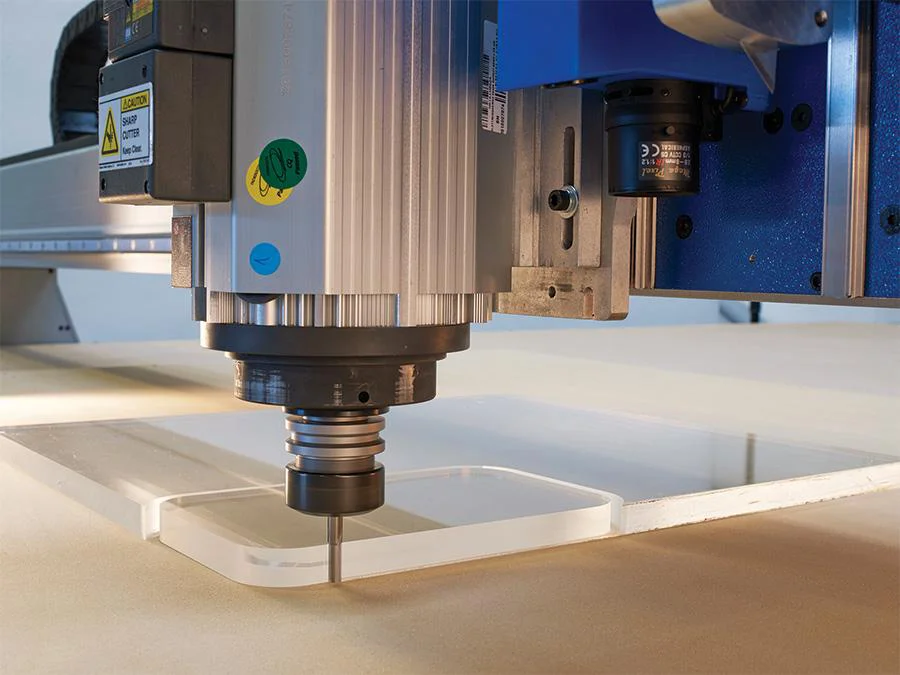
Yes. Extruded acrylic can be laser cut, CNC routed, drilled and edge polished using suitable equipment and processing techniques.
However, extruded acrylic can be more sensitive to heat and residual stress during some fabrication processes than cast acrylic.
Correct cutting speeds, tooling and stress management help reduce the risk of cracking, crazing or poor edge quality.
5. Is Extruded Acrylic Suitable for Illuminated Signage?
Yes. Extruded acrylic is widely used for illuminated signs, lightboxes and lighting applications.
Clear grades offer excellent light transmission, while suitable opal, translucent and coloured grades can provide light diffusion and decorative effects.
For illuminated signage, consider sheet thickness, light transmission, colour consistency and the required lighting arrangement.
6. Can Extruded Acrylic Be Used Outdoors?
Suitable UV-stable extruded acrylic grades provide good resistance to sunlight and weathering, making them useful for external signage and displays.
Outdoor installations must allow for thermal expansion and use suitable fixings.
Always check the manufacturer's specifications for long-term outdoor performance and any applicable warranty.
7. Can Extruded Acrylic Be Bent and Thermoformed?
Yes. Extruded acrylic can be heated, bent and thermoformed into a range of shapes.
Its consistent thickness can be beneficial for repeat manufacturing, including formed retail displays, signage components and protective covers.
Heating conditions, forming methods and cooling must be carefully controlled to achieve consistent results.
8. How Do You Clean Extruded Acrylic Sheet?
Extruded acrylic should be cleaned using mild soapy water and a soft, non-abrasive cloth.
Avoid acetone, aggressive solvents and abrasive cleaning products, which can damage the surface or cause stress cracking.
For commercial environments involving regular chemical cleaning, check the material's compatibility with the specific cleaning products being used.
9. Is Extruded Acrylic Fire Rated for Commercial Buildings?
Standard extruded acrylic is a combustible thermoplastic, and its fire classification depends on the particular grade, thickness and test method.
For commercial buildings, public areas and regulated installations, always check the manufacturer's fire test documentation and relevant building requirements.
Do not assume that standard extruded acrylic meets a specific fire classification without supporting evidence.
10. Can Extruded Acrylic Be Supplied in Commercial Quantities?
Extruded acrylic is available in full sheets and can be cut into smaller panels for commercial fabrication.
When ordering larger quantities, consider sheet size, thickness, colour, dimensional tolerances, batch consistency and delivery requirements.
For repeat manufacturing, confirming stock availability and the required material specification helps maintain consistency between orders.
Shop Extruded Acrylic Sheet for Commercial Projects
At Brissco, we supply acrylic sheet materials for signage, retail displays, shopfitting and general commercial fabrication.
Whether you require clear, coloured or specialist acrylic sheet, choosing the correct grade, thickness and dimensions will help ensure the material is suitable for your project.
Explore our acrylic sheet range or contact our team to discuss your commercial requirements.
Need to see it before you buy? We offer samples of our uPVC building products to help you choose the perfect fit. Simply get in touch through our contact page, and we’ll be happy to assist!

We use cookies on this site to enhance your user experience. For a complete overview of all cookies used, please see our Privacy Policy